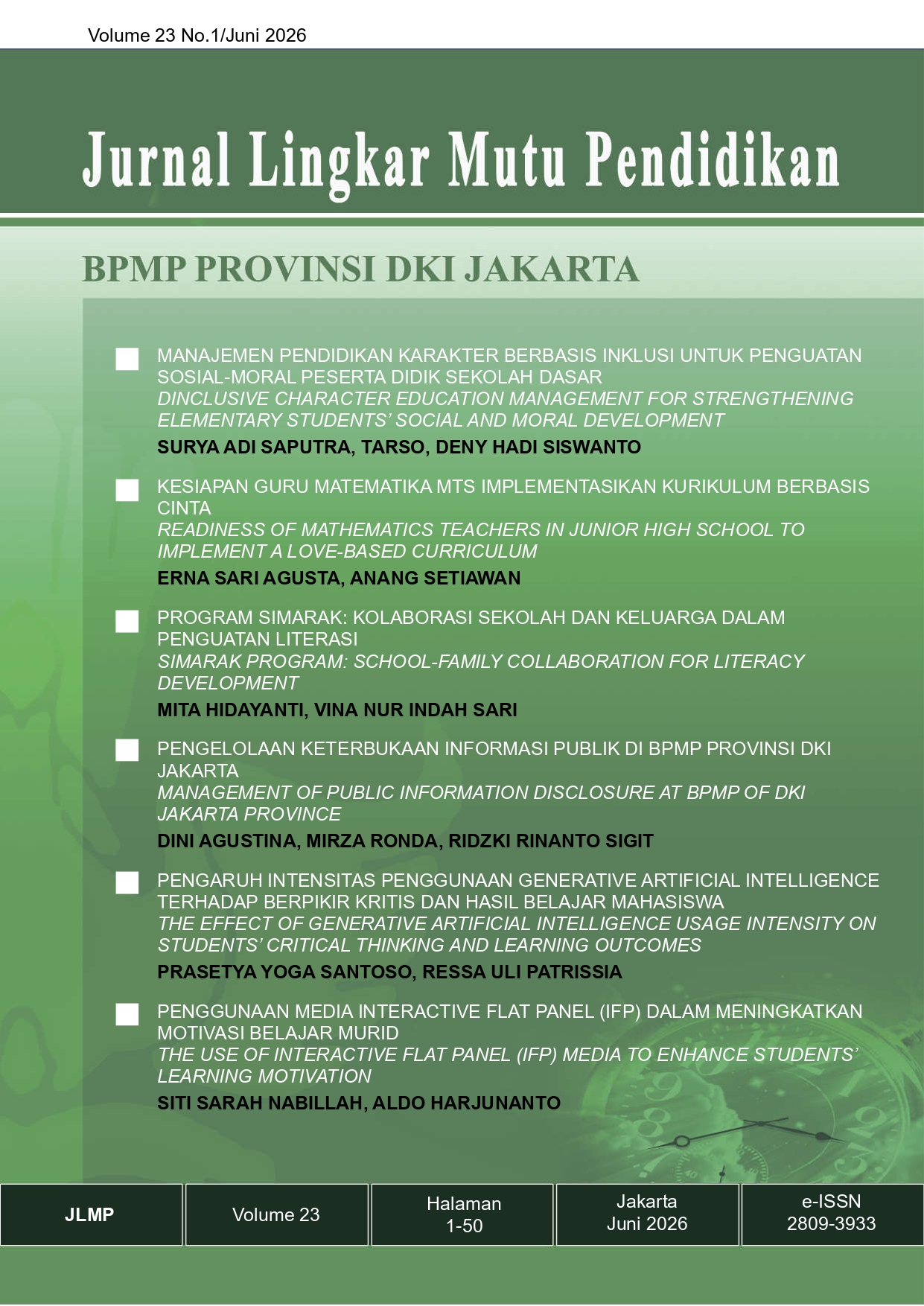
MANAGEMENT OF PUBLIC INFORMATION DISCLOSURE AT BPMP OF DKI JAKARTA PROVINCE
DOI:
https://doi.org/10.54124/jlmp.v23i1.189Keywords:
public information disclosure, organizational communication, information equivocality, sensemaking, public institutionsAbstract
Public information disclosure is a fundamental principle of democratic governance; however, its implementation in public institutions continues to face various challenges, particularly regarding the clarity and consistency of information. Previous studies indicate that issues of transparency are not solely related to regulatory compliance, but are also shaped by internal organizational communication processes that influence how information is interpreted and managed. This study aims to analyze the management of public information disclosure as an organizational communication process, with a focus on how public institutions address information equivocality. Employing a qualitative approach with an exploratory case study design, this research was conducted at the Educational Quality Assurance Agency (Balai Penjaminan Mutu Pendidikan/BPMP) of DKI Jakarta Province. Data were collected through observation, in-depth interviews with 13 informants, and document analysis, and were examined using thematic analysis supported by NVivo and communication network analysis using UCINET. The findings reveal that BPMP’s transformation from a non-informative to an informative public institution was achieved through a gradual process of reducing information equivocality, including meaning clarification, standardization of procedures and documents, strengthening internal communication and coordination, strategic leadership roles, and the optimization of communication networks and digital technologies. These results underscore that public information disclosure constitutes a complex and dynamic organizational communication process. This study contributes to the development of organizational communication scholarship in the public sector and offers practical implications for enhancing transparency strategies in public institutions.
Downloads
References
Apriliya, S. (2022). Peran Pejabat Pengelola Informasi dan Dokumentasi (PPID) dalam pelayanan informasi publik. Jurnal Administrasi Negara, 10(1), 77–89.
Ardina, R. (2021). Implementasi keterbukaan informasi publik pada badan publik daerah. Jurnal Ilmu Administrasi Publik, 9(2), 145–158.
Braun, V., & Clarke, V. (2006). Using thematic analysis in psychology. Qualitative Research in Psychology, 3(2), 77–101. https://doi.org/10.1191/1478088706qp063oa
Bungin, B. (2015). Penelitian kualitatif: Komunikasi, ekonomi, kebijakan publik, dan ilmu sosial lainnya (Edisi kedua). Kencana.
Creswell, J. W., & Poth, C. N. (2018). Qualitative inquiry and research design: Choosing among five approaches (4th ed.). Sage Publications.
Fitriani, D. (2023). Evaluasi keterbukaan informasi publik pada badan publik pemerintah. Jurnal Transparansi dan Akuntabilitas, 5(1), 23–38.
Grossi, G., Steccolini, I., & Reichard, C. (2020). Transparency and accountability in the public sector: A comparative perspective. Public Management Review, 22(8), 1107–1129. https://doi.org/10.1080/14719037.2019.1649699
Harrison, T. M. (2014). Open government, open data, and open innovation. Springer.
Kapahang, J. (2020). Tantangan implementasi Undang-Undang Keterbukaan Informasi Publik di pemerintah daerah. Jurnal Kebijakan Publik, 6(2), 101–115.
Lincoln, Y. S., & Guba, E. G. (1985). Naturalistic inquiry. Sage Publications.
Mahmud, A. (2020). Analisis jaringan komunikasi dalam organisasi publik. Jurnal Ilmu Komunikasi, 18(1), 55–70.
Monge, P. R., & Contractor, N. S. (2003). Theories of communication networks. Oxford University Press.
Mulyana, D. (2006). Metodologi penelitian kualitatif: Paradigma baru ilmu komunikasi dan ilmu sosial lainnya. Remaja Rosdakarya.
Munasti, R. (2022). Sensemaking dan pengelolaan informasi dalam organisasi. Jurnal Komunikasi Organisasi, 4(2), 133–147.
Nadilla, A. (2022). Pola jaringan komunikasi dan efektivitas informasi organisasi. Jurnal Studi Komunikasi, 6(3), 301–315.
Neuman, W. L. (2018). Social research methods: Qualitative and quantitative approaches (8th ed.). Pearson.
Noor, F. (2019). Implementasi keterbukaan informasi publik di Indonesia. Jurnal Administrasi Publik, 7(1), 1–14.
Patton, M. Q. (2015). Qualitative research & evaluation methods (4th ed.). Sage Publications.
Weick, K. E. (1995). Sensemaking in organizations. Sage Publications.
Yin, R. K. (2018). Case study research and applications: Design and methods (6th ed.). Sage Publications.
Yulia, N. (2019). Pengelolaan ambiguitas informasi dalam organisasi. Jurnal Ilmu Komunikasi, 17(2), 89–102.
Downloads
Published
How to Cite
Issue
Section
License
Copyright (c) 2026 Jurnal Lingkar Mutu Pendidikan

This work is licensed under a Creative Commons Attribution-NonCommercial-NoDerivatives 4.0 International License.
-
Attribution — You must give appropriate credit, provide a link to the license, and indicate if changes were made. You may do so in any reasonable manner, but not in any way that suggests the licensor endorses you or your use.
-
NonCommercial — You may not use the material for commercial purposes.
-
NoDerivatives — If you remix, transform, or build upon the material, you may not distribute the modified material.
- No additional restrictions — You may not apply legal terms or technological measures that legally restrict others from doing anything the license permits.