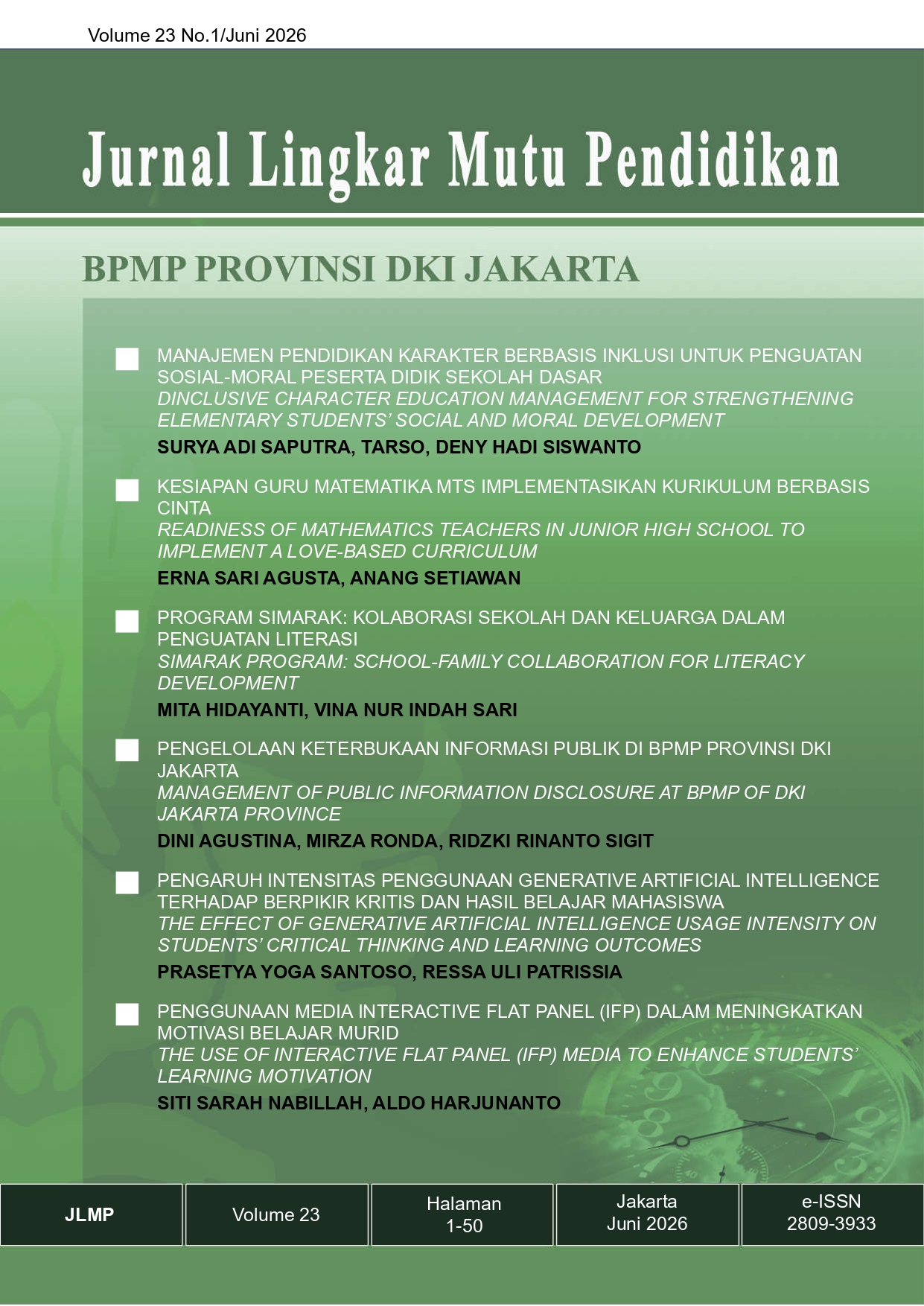
DINCLUSIVE CHARACTER EDUCATION MANAGEMENT FOR STRENGTHENING ELEMENTARY STUDENTS’ SOCIAL AND MORAL DEVELOPMENT
DOI:
https://doi.org/10.54124/jlmp.v23i1.201Keywords:
Education Management, Character Education, Special Needs Students, Inclusive SchoolAbstract
This research aims to explore in depth the management of character education for students with special needs (SEN) at SD Muhammadiyah Jogodayoh. Employing a qualitative approach with a descriptive case study design, data were collected through participatory observation, in-depth interviews with the principal and teachers, and documentation studies. The results indicate that character education management is implemented through four systematic stages. First, planning begins with multidimensional early identification and the integration of 18 character values into adaptive instructional designs. Second, organizing is carried out through classroom differentiation (regular, intensive, and transitional classes) and the implementation of co-teaching strategies to ensure equitable attention. Third, implementation focuses on the adaptation of the Merdeka Curriculum, prioritizing teacher role-modeling, religious habituation, and positive reinforcement. Fourth, routine weekly evaluations serve as quality control instruments for both student progress and teacher professional competence. The success of this model lies in the synergy between school and parents, as well as a shift in educational orientation from academic achievement to socio-moral maturity. The study concludes that structured management effectively creates a harmonious inclusive culture. It is recommended that the school strengthen collaboration with external experts and utilize assistive technology for more optimal character monitoring.
Downloads
References
Alinsunurin, J. (2020). School learning climate in the lens of parental involvement and school leadership: lessons for inclusiveness among public schools. Smart Learning Environments, 7(25), 1–23. https://doi.org/10.1186/s40561-020-00139-2
Ansori, Y. Z., Nahdi, D. S., Juanda, A., & Santoso, E. (2024). Developing the character of Elementary School students through values-based leadership. Al-Ishlah: Jurnal Pendidikan, 16(4), 5335–5344. https://doi.org/10.35445/alishlah.v16i4.5513
Athoillah, A. (2010). Dasar-Dasar Manajemen. Bandung: Pustaka Setia.
Bandura, A. (1977). Social Learning Theory. Prentice Hall.
Creswell, J. W., & Poth, C. N. (2018). Qualitative inquiry and research design: Choosing among five approaches (4th ed.). Sage.
Hakim, L., & Siswanto, D. H. (2026). Manajemen Sekolah Inklusi: Strategi Pengelolaan Pendidikan Ramah Keberagaman. Surabaya: Yayasan Andus Edukasi Indonesia.
Hidayati, E., Hadi Siswanto, D., Susetyawati, E., & Kintoko, K. (2026). Character Education through Tapak Suci: A Qualitative Case Study in Indonesian Senior High School. Journal of Educational Research and Practice (JERP, 4(1). https://doi.org/10.70376/jerp
Ilmi, Z., Padil, M., & Wahyuni, E. N. (2025). Moral Values Internalization to Foster Social Concern Toward Students with Disabilities in Inclusive Schools. SYAIKHUNA: Jurnal Pendidikan Dan Pranata Islam STAI Syichona Moh. Cholil Bangkalan, 16(02), 441–456. https://doi.org/10.62730/syaikhuna.v16i02.7692
Indraswati, D., & Widodo, A. (2021). Implementasi manajemen pengendalian mutu di sekolah. Jurnal Dinamika Manajemen Pendidikan, 5(2), 104–113.
Jortveit, M., & Kovač, V. B. (2022). Co-teaching that works: special and general educators’ perspectives on collaboration. Teaching Education, 33(3), 286–300. https://doi.org/10.1080/10476210.2021.1895105
Jurkowski, S., Ulrich, M., & Müller, B. (2023). Co-teaching as a resource for inclusive classes: teachers’ perspectives on conditions for successful collaboration. International Journal of Inclusive Education, 27(1), 54–71. https://doi.org/10.1080/13603116.2020.1821449
Knaus, T. (2023). Emotions in Media Education: How media based emotions enrich classroom teaching and learning. Social Sciences and Humanities Open, 8(1), 100504. https://doi.org/10.1016/j.ssaho.2023.100504
Korthals Altes, T., Willemse, M., Goei, S. L., & Ehren, M. (2024). Higher education teachers’ understandings of and challenges for inclusion and inclusive learning environments: A systematic literature review. Educational Research Review, 43(June 2023), 100605. https://doi.org/10.1016/j.edurev.2024.100605
Lapidot-Lefler, N. (2025). Teacher Responsiveness in Inclusive Education: A Participatory Study of Pedagogical Practice, Well-Being, and Sustainability. Sustainability (Switzerland), 17(7). https://doi.org/10.3390/su17072919
Lau, H., Aryaningrat, R. A. R., & Rosmaladewi, O. (2023). Workshop Kompetensi Guru Inklusi Untuk Meningkatkan Pembelajaran Siswa Sekolah Dasar Inklusif Di Kecamatan Cililin. Jurnal Ilmu Pendidikan (ILPEN), 2(1), 1–12. https://jurnal.azkahafidzmaulana.my.id/index.php/ilpen/article/view/24
Lickona, T. (2012). Educating for character: How our schools can teach respect and responsibility. Bantam Books.
Mala, R., Surya, P., & Soswanto, D. H. (2025). Managing Character Education for Students with Special Needs: A Framework of Planning, Organizing, Implementation and Evaluation. ITQAN: Jurnal Ilmu-Ilmu Kependidikan, 16(1), 65–76.
Miles, M. B., & Huberman, A. M. (1994). Qualitative Data Analysis: An Expanded Sourcebook. In Qualitative Data Analysis: An Expanded Sourcebook (pp. 1–318).
Mubarokah, S. (2022). Tantangan Implementasi Pendekatan TaRL (Teaching at the Right Level) dalam Literasi Dasar yang Inklusif di Madrasah Ibtida’iyah Lombok Timur. BADA’A: Jurnal Ilmiah Pendidikan, 4(1), 165–179. https://doi.org/10.37216/badaa.v4i1.582
Navas-Bonilla, C. del R., Guerra-Arango, J. A., Oviedo-Guado, D. A., & Murillo-Noriega, D. E. (2025). Inclusive education through technology: A systematic review of types, tools and characteristics. Frontiers in Education, 10(February), 1–22. https://doi.org/10.3389/feduc.2025.1527851
Nirma, N., Pratama, R. A., & Permatasari, B. I. (2021). Media Pembelajaran Buku Pintar (BUPI) Matematika Bagi Anak Berkebutuhan Khusus (ABK). Jurnal Cendekia: Jurnal Pendidikan Matematika, 5(2), 1359–1374.
Perrin, A. L., Jury, M., & Desombre, C. (2021). Are teachers’ personal values related to their attitudes toward inclusive education? A correlational study. Social Psychology of Education, 24(4), 1085–1104. https://doi.org/10.1007/s11218-021-09646-7
Rahmawati, U. N., Nashori, F., & Rachmahana, R. S. (2020). Pelatihan Mindfulness Teaching untuk Meningkatkan Kesejahteraan Subjektif Guru Sekolah Inklusi. Psympathic : Jurnal Ilmiah Psikologi, 7(1), 49–60. https://doi.org/10.15575/psy.v7i1.8241
Ramadhani, T., Widiyanta, D., Sumayana, Y., Santoso, R. Y., Agustin, P. D., & Al-Amin. (2024). The Role of Character Education In Forming Ethical and Responsible Students. IJGIE-International Journal of Graduated of Islamic Education, 5(2), 110–124.
Rambe, M. Y., Tanikawa, K., & Siswanto, D. H. (2025). Economics Education with Islamic Character Values: Fostering Frugality and Responsibility among High School Students. RUKASI: Jurnal Ilmiah Perkembangan Penedidikan Dan Pembelajaran, 02(05), 213–219.
Riani, S. S., & Ain, S. Q. (2022). The Role of School Principal in Implementing Education Quality Management. Jurnal Ilmiah Sekolah Dasar, 6(2), 204–211. https://doi.org/10.23887/jisd.v6i2.45216
Roberts, J., & Webster, A. (2022). Including students with autism in schools: a whole school approach to improve outcomes for students with autism. International Journal of Inclusive Education, 26(7), 701–718. https://doi.org/10.1080/13603116.2020.1712622
Rokhani, C. T. S. (2020). Pengaruh Gaya Kepemimpinan Kepala Sekolah Terhadap Kinerja Sekolah di SDN Dengkek 01 Pati. Journal Industrial Engineering & Management Research ( Jiemar), 1(2), 1–8. https://doi.org/10.7777/jiemar.v1i2
Rönn-Liljenfeldt, M., Sundqvist, C., Ström, K., & Korhonen, J. (2024). Students’ perceptions of co-teaching in the general classroom. European Journal of Special Needs Education, 39(2), 311–326. https://doi.org/10.1080/08856257.2023.2215008
Sari, C. P., Fidiawati, L., & Kustina, R. (2025). Buku Ajar Pendidikan Inklusif dan Anak Berkebutuhan Khusus. Banda Aceh: Bandar Publishing.
Schell, C. S., Dignath, C., Kleen, H., John, N., & Kunter, M. (2024). Judging a book by its cover? Investigating pre-service teacher’s stereotypes towards pupils with special educational needs. Teaching and Teacher Education, 142(December 2023), 104526. https://doi.org/10.1016/j.tate.2024.104526
Solissa, E. M., Hayati, A. A., Rukhmana, T., Muharam, S., Mardikawati, B., & Irmawati. (2020). Mengembangkan Pendidikan Karakter Berbasis Budaya Menuju Society 5.0. Journal on Education, 06(02), 11327–11333. https://www.upy.ac.id/berita/mengembangkan-pendidikan-karakter-berbasis-budaya-menuju-society-50
Sunaedi, A., & Rudji, H. (2023). Supervisi akademik kepala sekolah dalam meningkatkan kinerja guru di Madrasah Aliyah Negeri Tolitoli. Journal of Educational Management and Islamic Leadership, 2(2), 1–17.
Susanti, S., Fakhrul Uman, A., Aida fitriyah Ridwan, S., & Maf’ulah, S. (2023). Manajemen Peran Kepala Sekolah Dalam Meningkatkan Mutu Pendidikan. Jurnal Impresi Indonesia, 2(6), 574–581. https://doi.org/10.58344/jii.v2i6.2916
Uria-Olaizola, N., Yurrebaso Atutxa, G., & León-Guereño, P. (2025). The Impact of Programs Aimed at Raising Awareness About Children with Intellectual and Developmental Disabilities in Schools: A Systematic Review. In Education Sciences (Vol. 15, Number 2). Multidisciplinary Digital Publishing Institute (MDPI). https://doi.org/10.3390/educsci15020151
Vlachou, A., & Tsirantonaki, S. S. (2023). The Importance of School Principals’ Values towards the Inclusive Education of Disabled Students: Associations between Their Values and Knowledge, Beliefs, Attitudes and Practices. Education Sciences, 13(4), 1–21. https://doi.org/10.3390/educsci13040360
Wang, C., & Si, L. (2024). The intersection of public policy and public access: digital inclusion, digital literacy education, and libraries. Sustainability (Switzerland), 16(5), 1–22.
Woolfson, L. M. (2024). Is inclusive education for children with special educational needs and disabilities an impossible dream? British Journal of Educational Psychology, (November 2023), 1–13. https://doi.org/10.1111/bjep.12701
Yunaini, N., Mustadi, A., Mumpuniarti, Ishartiwi, & Hidayat, R. (2024). Differentiated instruction science learning for intellectually disabilities pupils at an inclusive primary school: A case study. Journal of Turkish Science Education, 21(3), 467–483. https://doi.org/10.36681/tused.2024.025
Downloads
Published
How to Cite
Issue
Section
License
Copyright (c) 2026 Jurnal Lingkar Mutu Pendidikan

This work is licensed under a Creative Commons Attribution-NonCommercial-NoDerivatives 4.0 International License.
-
Attribution — You must give appropriate credit, provide a link to the license, and indicate if changes were made. You may do so in any reasonable manner, but not in any way that suggests the licensor endorses you or your use.
-
NonCommercial — You may not use the material for commercial purposes.
-
NoDerivatives — If you remix, transform, or build upon the material, you may not distribute the modified material.
- No additional restrictions — You may not apply legal terms or technological measures that legally restrict others from doing anything the license permits.