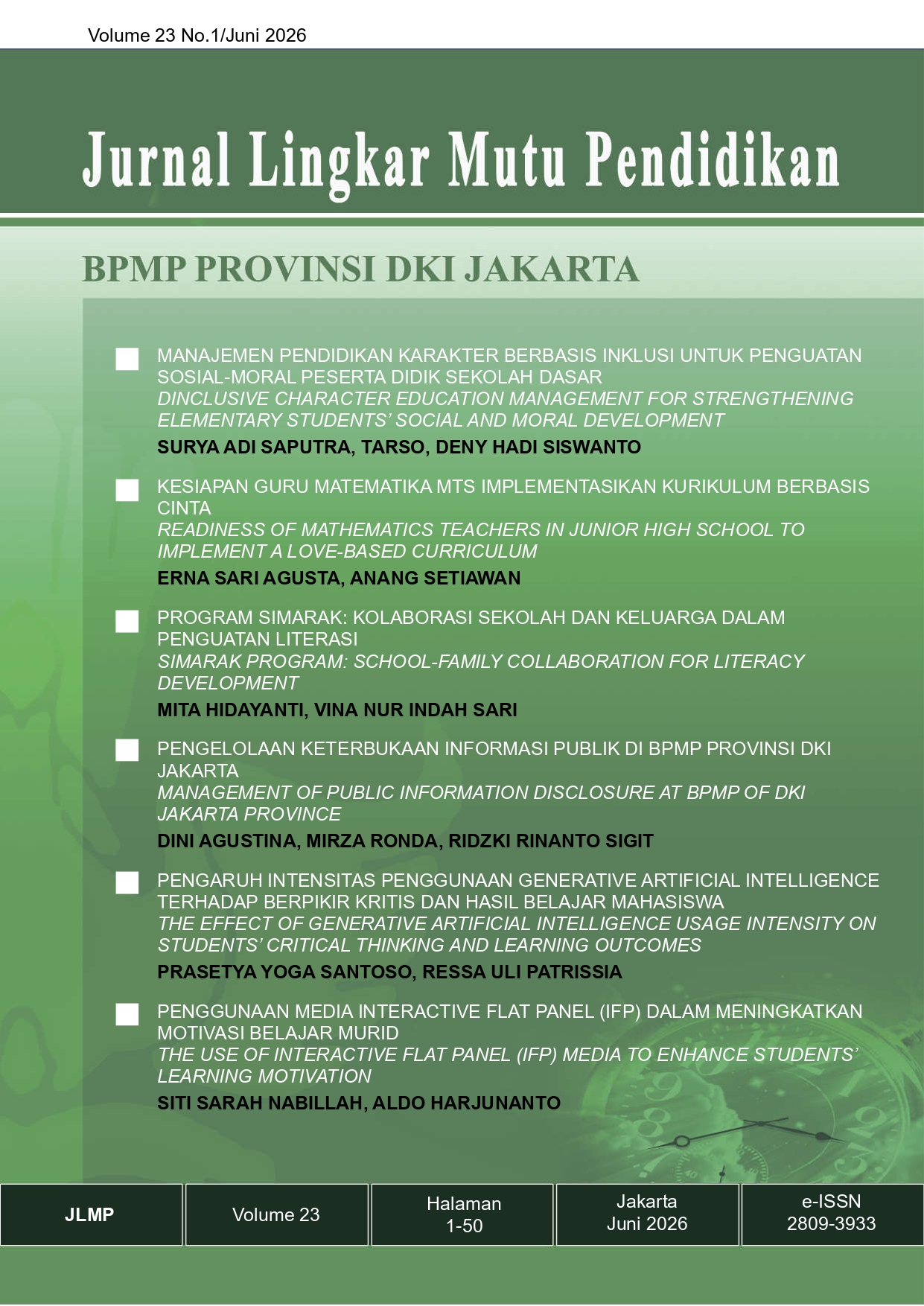
THE USE OF INTERACTIVE FLAT PANEL (IFP) MEDIA TO ENHANCE STUDENTS’ LEARNING MOTIVATION
DOI:
https://doi.org/10.54124/jlmp.v23i1.190Keywords:
Interactive Flat Panel (IFP), learning motivation, educational technology, interactive learning, elementary schoolAbstract
Abstract. To raise the standard of instruction in schools in the technologically advanced 21st century, education must innovate. The usage of the Interactive Flat Panel (IFP) as a learning tool is one of the new developments; it has many benefits for making the teaching and learning process more dynamic and interesting. The purpose of this research is to investigate how the usage of Interactive Flat Panel (IFP) may boost students' enthusiasm to learn at SDN Cipinang Besar Utara 01, which has struggled with student engagement and active involvement. The study used a descriptive qualitative methodology, gathering information via documentation, interviews, and observation. The research looks at how kids' desire to learn is affected by the usage of IFP as an interactive learning medium in primary schools, which is currently comparatively rare. The findings show that using IFP greatly boosts students' interest in learning, promotes active engagement, and improves their drive to study. Additionally, IFP makes it easier for pupils to get educational content in a way that is more visually appealing and simple to comprehend. Based on these results, it is advised that educational policies promote the wider use of IFP in primary schools by giving teachers extensive training and sufficient resources to guarantee the best possible use of technology in the classroom.
Keywords: Interactive Flat Panel (IFP), learning motivation, educational technology, interactive learning, elementary school.
Downloads
References
Aini, Q., Rahardja, U., & Khoirunisa, A. (2020). Blockchain Technology into Gamification on Education. IJCCS (Indonesian Journal of Computing and Cybernetics Systems), 14(2), 147. https://doi.org/10.22146/ijccs.53221
Azzahra, A. F., & Setiawan, D. (2025). Problem Based Learning Model Assisted by Crossword Puzzles on the Learning Outcomes of Grade III Elementary School Pancasila Education Subjects Material Meaning of the Meaning of the Precepts of Pancasila. Jurnal Imiah Pendidikan Dan Pembelajaran, 9(2), 363–373. https://doi.org/10.23887/jipp.v9i2.93708
Bedenlier, S., Bond, M., Buntins, K., Zawacki-Richter, O., & Kerres, M. (2020). Facilitating student engagement through educational technology in higher education: A systematic review in the field of arts and humanities. Australasian Journal of Educational Technology, 36(4), 126–150. https://doi.org/10.14742/AJET.5477
Book : E-Learning in the 21st Century. (2017). 2017.
Cohen, L., & McIntyre, A. (2024). Integrating Technology in Elementary Education : Nternational Education and Research Journal.Q, 8, 16–18.
Elsa Oskarita, & Hadid Nur’afra Arasy. (2024). The Role of Digital Tools in Enhancing Collaborative Learning in Secondary Education. International Journal of Educational Research, 1(1), 26–32. https://doi.org/10.62951/ijer.v1i1.15
Ertmer, P. A., & Ottenbreit-Leftwich, A. T. (2010). Teacher Technology Change. Journal of Research on Technology in Education, 42(3), 255–284. https://doi.org/10.1080/15391523.2010.10782551
Harasim, L. (2018). Introduction to Learning Theory and Technology. In Learning Theory and Online Technologies. https://doi.org/10.4324/9781315716831-1
Hayati, R. (2025). Learning Revolution with Integrated Gamification Technology and Realistic Mathematics Education Models for Contextual and Interesting Learning. Journal of Hunan University Natural Sciences, 52(Volume 52, Issue 2). https://doi.org/10.55463/issn.1674-2974.52.2.7
Hendrizal. (2020). Rendahnya Motivasi Belajar Siswa Dalam Proses Pembelajaran. Jurnal Riset Pendidikan Dasar Dan Karakter, 2(1), 44–53. https://ojs.adzkia.ac.id/index.php/pdk/article/view/57/48
Kusuma, J. W., & Hamidah, H. (2020). Perbandingan Hasil Belajar Matematika Dengan Penggunaan Platform Whatsapp Group Dan Webinar Zoom Dalam Pembelajaran Jarak Jauh Pada Masa Pandemik Covid 19. JIPMat, 5(1). https://doi.org/10.26877/jipmat.v5i1.5942
Mayer, R. E. (2024). The Past, Present, and Future of the Cognitive Theory of Multimedia Learning. Educational Psychology Review, 36(1), 1–25. https://doi.org/10.1007/s10648-023-09842-1
Miles, M., Huberman, A., & Saldaña, J. (2014). Designing matrix and network displays. Qualitative Data Analysis A Methods Sourcebook, 107–119.
Nadila. (2024). Pemanfaatan Teknologi Digital Dalam Pembelajaran. JUPSI: Jurnal Pendidikan Sosial Indonesia, 2(1), 37–46. https://doi.org/10.62238/jupsijurnalpendidikansosialindonesia.v2i1.72
Schindler, L. A., Burkholder, G. J., Morad, O. A., & Marsh, C. (2017). Computer-based technology and student engagement: a critical review of the literature. International Journal of Educational Technology in Higher Education, 14(1). https://doi.org/10.1186/s41239-017-0063-0
Selwyn, N. (2021). Ed-Tech Within Limits: Anticipating educational technology in times of environmental crisis. E-Learning and Digital Media, 18(5), 496–510. https://doi.org/10.1177/20427530211022951
Shank, E., Tang, H., & Morris, W. (2025). Motivation in online course design using self-determination theory: an action research study in a secondary mathematics course. Educational Technology Research and Development, 73(1), 415–441. https://doi.org/10.1007/s11423-024-10410-9
Suhud, S. (2024). Hattie’s Visible Learning Evaluation Model in Learning Strategies and Publication of Scientific Work of IKIP Siliwangi Students. JLER (Journal of Language Education Research), 7(1), 17–26. https://doi.org/10.22460/jler.v7i1.21692
Syafira, P., Novaliza, S., Sulistianingsih, R., Restaryy, T. I., & Lasha, V. (2024). Evaluasi Penggunaan Media Pembelajaran Interaktif dalam Meningkatkan Minat Belajar Siswa di Sekolah Dasar. Action Research Journal Indonesia (ARJI), 6(3), 2092–2097. https://doi.org/10.61227/arji.v6i3.196
Tate, T., & Warschauer, M. (2022). Equity in online learning. Educational Psychologist, 57(3), 192–206. https://doi.org/10.1080/00461520.2022.2062597
Downloads
Published
How to Cite
Issue
Section
License
Copyright (c) 2026 Jurnal Lingkar Mutu Pendidikan

This work is licensed under a Creative Commons Attribution-NonCommercial-NoDerivatives 4.0 International License.
-
Attribution — You must give appropriate credit, provide a link to the license, and indicate if changes were made. You may do so in any reasonable manner, but not in any way that suggests the licensor endorses you or your use.
-
NonCommercial — You may not use the material for commercial purposes.
-
NoDerivatives — If you remix, transform, or build upon the material, you may not distribute the modified material.
- No additional restrictions — You may not apply legal terms or technological measures that legally restrict others from doing anything the license permits.