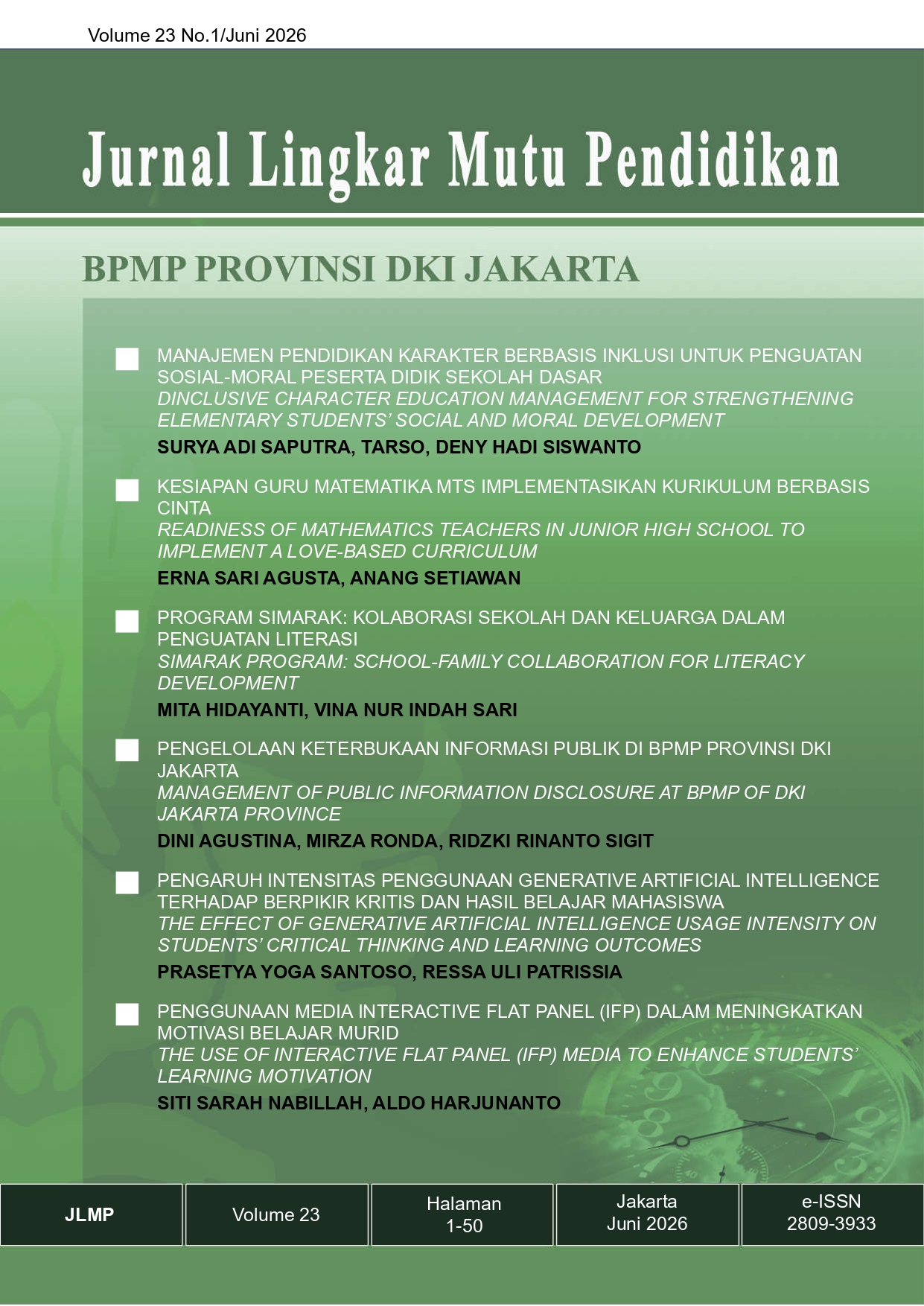
SIMARAK PROGRAM: SCHOOL-FAMILY COLLABORATION FOR LITERACY DEVELOPMENT
DOI:
https://doi.org/10.54124/jlmp.v23i1.187Keywords:
literacy development, family literacy, school–family collaboration, parental involvement, students’ reading habitsAbstract
This study aims to describe the implementation of the SIMARAK (Students Reading with Family) program as a form of collaboration between schools and families in strengthening literacy among elementary school students. The study employed a descriptive qualitative approach with data collected through open-ended questionnaires distributed to teachers, parents, and students involved in the SIMARAK program. The data were analyzed through data reduction, data display, and conclusion drawing to identify patterns of program implementation, forms of family involvement in shared reading activities, and their impact on students’ reading habits. The findings indicate that the SIMARAK program extends literacy practices from the school environment to the home through shared reading activities involving parents directly. Family participation in reading activities provides opportunities for students to interact more intensively with texts, fosters reading interest, and increases students’ engagement in literacy activities. Literacy interactions between parents and children during shared reading also contribute to improving reading comprehension and developing students’ reading habits. The findings suggest that the SIMARAK program can serve as a strategy for strengthening students’ literacy through family literacy practices integrated with school literacy programs. Therefore, collaboration between schools and families through shared reading activities has the potential to support the development of a sustainable literacy culture among elementary school students.
Downloads
References
Boonk, L., Gijselaers, H. J. M., Ritzen, H., & Brand-Gruwel, S. (2018). A review of the relationship between parental involvement indicators and academic achievement. Educational Research Review, 24, 10–30. https://doi.org/10.1016/j.edurev.2018.02.001
Burgess, S. R., Hecht, S. A., & Lonigan, C. J. (2002). Relations of the Home Literacy Environment to the Development of Reading-Related Abilities. Reading Research Quarterly, 37(4), 408–426. https://doi.org/10.1598/RRQ.37.4.4
Dolean, D. D., Melby-Lerv�g, M., Tincas, I., Damsa, C., & Lerv�g, A. (2019). Achievement gap: Socioeconomic status affects reading development beyond language and cognition in children facing poverty. Learning and Instruction, 63, 101218. https://doi.org/10.1016/j.learninstruc.2019.101218
Froiland, J. M., Davison, M. L., Zucker, T. A., Cabell, S. Q., Justice, L. M., Pentimonti, J. M., Kaderavek, J. N., Neumann, M. M., Park, S., Mol, S. E., Bus, A. G., Niklas, F., Schneider, W., Burgess, S. R., Hecht, S. A., Lonigan, C. J., Goodall, J., Montgomery, C., Guthrie, J. T., … Ho, A. N. (2018). Home Literacy Environment and the Beginning of Reading and Spelling. Educational Psychology Review, 40(1), 1–16. https://doi.org/10.1037/bul0000003
Fullan, M., Quinn, J., & McEachen, J. (2020). Deep learning: Engage the world change the world. Corwin.
Goodall, J. (2018). Parental engagement in children�s learning: Parents� perspectives on the impact of learning at home. Educational Review, 70(3), 1–15.
Guthrie, J. T., Klauda, S. L., & Ho, A. N. (2016). Modeling the relationships among reading instruction, motivation, engagement, and achievement for adolescents. Reading Research Quarterly, 51(1), 9–26.
Jeynes, W. (2016). A Meta-Analysis on the Effects of Parental Involvement on Students’ Academic Outcomes. Urban Education, 51(4), 1–24.
Krashen, S. (2018). Free voluntary reading: New research, applications, and controversies. Libraries Unlimited.
Logan, J. A. R., Justice, L. M., Yumus, M., & Chaparro-Moreno, L. J. (2019). When children are not read to at home: The million word gap. Journal of Developmental and Behavioral Pediatrics, 40(5), 383–386.
Mol, S. E., Bus, A. G., de Jong, M. T., & Smeets, D. J. H. (2019). Added value of dialogic parent�child book readings: A meta-analysis. Early Education and Development, 30(6), 1–21.
Niklas, F., Cohrssen, C., & Tayler, C. (2020). Improving Preschoolers’ Language and Literacy Skills Through Home Literacy Environment. Early Childhood Research Quarterly, 50, 1–11.
Niklas, F., & Schneider, W. (2017). Home Literacy Environment and the Beginning of Reading and Spelling. Frontiers in Psychology, 8. https://doi.org/10.3389/fpsyg.2017.01097
OECD. (2021). 21st-century readers: Developing literacy skills in a digital world. OECD Publishing.
Schiefele, U., Schaffner, E., M�ller, J., & Wigfield, A. (2016). Dimensions of reading motivation and their relation to reading behavior and competence. Reading Research Quarterly, 51(4), 427–463.
Sénéchal, M. (2017). The Role of Parents in the Development of Reading Skills. In Handbook of Early Literacy Research (Vol. 3, pp. 1–16).
Senechal, M., & Young, L. (2008). The Effect of Family Literacy Interventions on Children’s Reading Acquisition. Review of Educational Research, 78(4), 880–907. https://doi.org/10.3102/0034654308320319
Silinskas, G., Lerkkanen, M.-K., Torppa, M., & Nurmi, J.-E. (2020). Home literacy activities and children�s reading skills, independent reading, and interest in literacy. Learning and Instruction, 66, 101310.
Snow, C. E. (2020). Reading comprehension: Reading for learning. In The Cambridge Handbook of Literacy. Cambridge University Press.
Tamis-LeMonda, C. S., Kuchirko, Y., & Song, L. (2019). Why is infant language learning facilitated by parental responsiveness? Current Directions in Psychological Science, 28(4), 384–390.
Torppa, M., Niemi, P., Vasalampi, K., & Lerkkanen, M.-K. (2022). Leisure reading and reading comprehension. Reading Research Quarterly, 57(2), 421–440.
Torppa, M., Silinskas, G., & Nurmi, J.-E. (2020). Home Literacy Environment and Early Reading Development. Reading and Writing, 33(2), 1–21.
UNESCO. (2023). Digital transformation in education: Policy brief. UNESCO.
Downloads
Published
How to Cite
Issue
Section
License
Copyright (c) 2026 Jurnal Lingkar Mutu Pendidikan

This work is licensed under a Creative Commons Attribution-NonCommercial-NoDerivatives 4.0 International License.
-
Attribution — You must give appropriate credit, provide a link to the license, and indicate if changes were made. You may do so in any reasonable manner, but not in any way that suggests the licensor endorses you or your use.
-
NonCommercial — You may not use the material for commercial purposes.
-
NoDerivatives — If you remix, transform, or build upon the material, you may not distribute the modified material.
- No additional restrictions — You may not apply legal terms or technological measures that legally restrict others from doing anything the license permits.