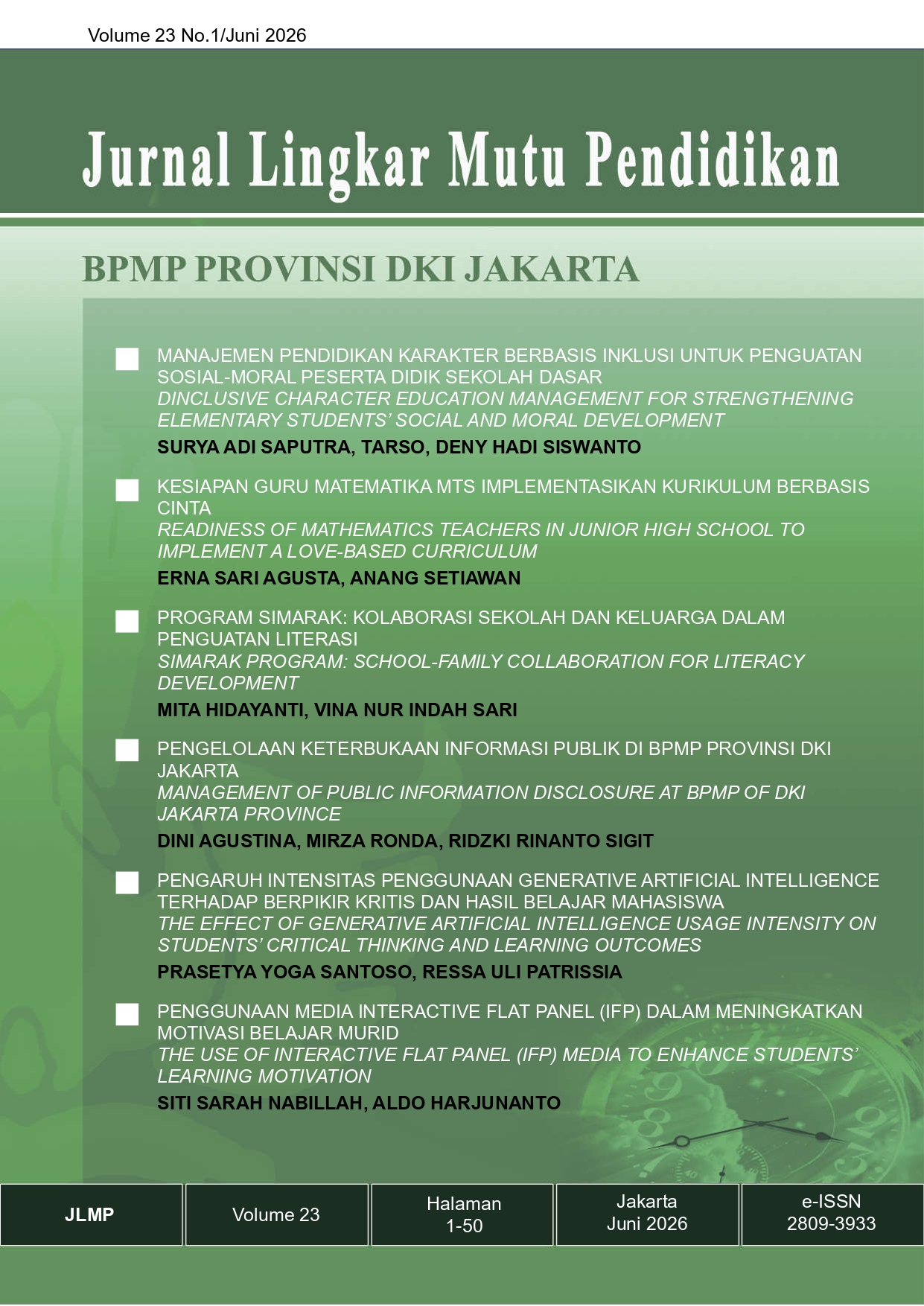
PROGRAM SIMARAK: KOLABORASI SEKOLAH DAN KELUARGA DALAM PENGUATAN LITERASI
DOI:
https://doi.org/10.54124/jlmp.v23i1.187Kata Kunci:
penguatan literasi, literasi keluarga, kolaborasi sekolah dan keluarga, keterlibatan orang tua, kebiasaan membaca siswaAbstrak
Penelitian ini bertujuan untuk mendeskripsikan pelaksanaan program SIMARAK (Siswa Membaca Bersama Keluarga) sebagai bentuk kolaborasi antara sekolah dan keluarga dalam penguatan literasi siswa sekolah dasar. Penelitian menggunakan pendekatan kualitatif deskriptif dengan teknik pengumpulan data melalui angket terbuka yang diberikan kepada guru, orang tua, dan siswa yang terlibat dalam program SIMARAK. Data dianalisis melalui tahapan reduksi data, penyajian data, dan penarikan simpulan untuk mengidentifikasi pola pelaksanaan program, bentuk keterlibatan keluarga dalam kegiatan membaca bersama, serta dampaknya terhadap kebiasaan membaca siswa. Hasil penelitian menunjukkan bahwa program SIMARAK memperluas praktik literasi dari lingkungan sekolah ke lingkungan keluarga melalui kegiatan membaca bersama yang melibatkan orang tua secara aktif. Keterlibatan keluarga dalam aktivitas membaca memberikan kesempatan bagi siswa untuk berinteraksi dengan teks secara lebih intensif, menumbuhkan minat membaca, serta meningkatkan keterlibatan siswa dalam kegiatan literasi. Interaksi literasi antara orang tua dan anak selama kegiatan membaca bersama juga berkontribusi terhadap peningkatan pemahaman bacaan dan kebiasaan membaca siswa. Temuan penelitian ini menunjukkan bahwa program SIMARAK dapat menjadi salah satu strategi penguatan literasi siswa melalui praktik literasi keluarga yang terintegrasi dengan program literasi sekolah. Dengan demikian, kolaborasi antara sekolah dan keluarga melalui kegiatan membaca bersama memiliki potensi untuk mendukung pengembangan budaya literasi yang lebih berkelanjutan pada siswa sekolah dasar.
Unduhan
Referensi
Boonk, L., Gijselaers, H. J. M., Ritzen, H., & Brand-Gruwel, S. (2018). A review of the relationship between parental involvement indicators and academic achievement. Educational Research Review, 24, 10–30. https://doi.org/10.1016/j.edurev.2018.02.001
Burgess, S. R., Hecht, S. A., & Lonigan, C. J. (2002). Relations of the Home Literacy Environment to the Development of Reading-Related Abilities. Reading Research Quarterly, 37(4), 408–426. https://doi.org/10.1598/RRQ.37.4.4
Dolean, D. D., Melby-Lerv�g, M., Tincas, I., Damsa, C., & Lerv�g, A. (2019). Achievement gap: Socioeconomic status affects reading development beyond language and cognition in children facing poverty. Learning and Instruction, 63, 101218. https://doi.org/10.1016/j.learninstruc.2019.101218
Froiland, J. M., Davison, M. L., Zucker, T. A., Cabell, S. Q., Justice, L. M., Pentimonti, J. M., Kaderavek, J. N., Neumann, M. M., Park, S., Mol, S. E., Bus, A. G., Niklas, F., Schneider, W., Burgess, S. R., Hecht, S. A., Lonigan, C. J., Goodall, J., Montgomery, C., Guthrie, J. T., … Ho, A. N. (2018). Home Literacy Environment and the Beginning of Reading and Spelling. Educational Psychology Review, 40(1), 1–16. https://doi.org/10.1037/bul0000003
Fullan, M., Quinn, J., & McEachen, J. (2020). Deep learning: Engage the world change the world. Corwin.
Goodall, J. (2018). Parental engagement in children�s learning: Parents� perspectives on the impact of learning at home. Educational Review, 70(3), 1–15.
Guthrie, J. T., Klauda, S. L., & Ho, A. N. (2016). Modeling the relationships among reading instruction, motivation, engagement, and achievement for adolescents. Reading Research Quarterly, 51(1), 9–26.
Jeynes, W. (2016). A Meta-Analysis on the Effects of Parental Involvement on Students’ Academic Outcomes. Urban Education, 51(4), 1–24.
Krashen, S. (2018). Free voluntary reading: New research, applications, and controversies. Libraries Unlimited.
Logan, J. A. R., Justice, L. M., Yumus, M., & Chaparro-Moreno, L. J. (2019). When children are not read to at home: The million word gap. Journal of Developmental and Behavioral Pediatrics, 40(5), 383–386.
Mol, S. E., Bus, A. G., de Jong, M. T., & Smeets, D. J. H. (2019). Added value of dialogic parent�child book readings: A meta-analysis. Early Education and Development, 30(6), 1–21.
Niklas, F., Cohrssen, C., & Tayler, C. (2020). Improving Preschoolers’ Language and Literacy Skills Through Home Literacy Environment. Early Childhood Research Quarterly, 50, 1–11.
Niklas, F., & Schneider, W. (2017). Home Literacy Environment and the Beginning of Reading and Spelling. Frontiers in Psychology, 8. https://doi.org/10.3389/fpsyg.2017.01097
OECD. (2021). 21st-century readers: Developing literacy skills in a digital world. OECD Publishing.
Schiefele, U., Schaffner, E., M�ller, J., & Wigfield, A. (2016). Dimensions of reading motivation and their relation to reading behavior and competence. Reading Research Quarterly, 51(4), 427–463.
Sénéchal, M. (2017). The Role of Parents in the Development of Reading Skills. In Handbook of Early Literacy Research (Vol. 3, pp. 1–16).
Senechal, M., & Young, L. (2008). The Effect of Family Literacy Interventions on Children’s Reading Acquisition. Review of Educational Research, 78(4), 880–907. https://doi.org/10.3102/0034654308320319
Silinskas, G., Lerkkanen, M.-K., Torppa, M., & Nurmi, J.-E. (2020). Home literacy activities and children�s reading skills, independent reading, and interest in literacy. Learning and Instruction, 66, 101310.
Snow, C. E. (2020). Reading comprehension: Reading for learning. In The Cambridge Handbook of Literacy. Cambridge University Press.
Tamis-LeMonda, C. S., Kuchirko, Y., & Song, L. (2019). Why is infant language learning facilitated by parental responsiveness? Current Directions in Psychological Science, 28(4), 384–390.
Torppa, M., Niemi, P., Vasalampi, K., & Lerkkanen, M.-K. (2022). Leisure reading and reading comprehension. Reading Research Quarterly, 57(2), 421–440.
Torppa, M., Silinskas, G., & Nurmi, J.-E. (2020). Home Literacy Environment and Early Reading Development. Reading and Writing, 33(2), 1–21.
UNESCO. (2023). Digital transformation in education: Policy brief. UNESCO.
Unduhan
Diterbitkan
Cara Mengutip
Terbitan
Bagian
Lisensi
Hak Cipta (c) 2026 Jurnal Lingkar Mutu Pendidikan

Artikel ini berlisensi Creative Commons Attribution-NonCommercial-NoDerivatives 4.0 International License.
-
Attribution — You must give appropriate credit, provide a link to the license, and indicate if changes were made. You may do so in any reasonable manner, but not in any way that suggests the licensor endorses you or your use.
-
NonCommercial — You may not use the material for commercial purposes.
-
NoDerivatives — If you remix, transform, or build upon the material, you may not distribute the modified material.
- No additional restrictions — You may not apply legal terms or technological measures that legally restrict others from doing anything the license permits.